 Position:
Socks Market Size
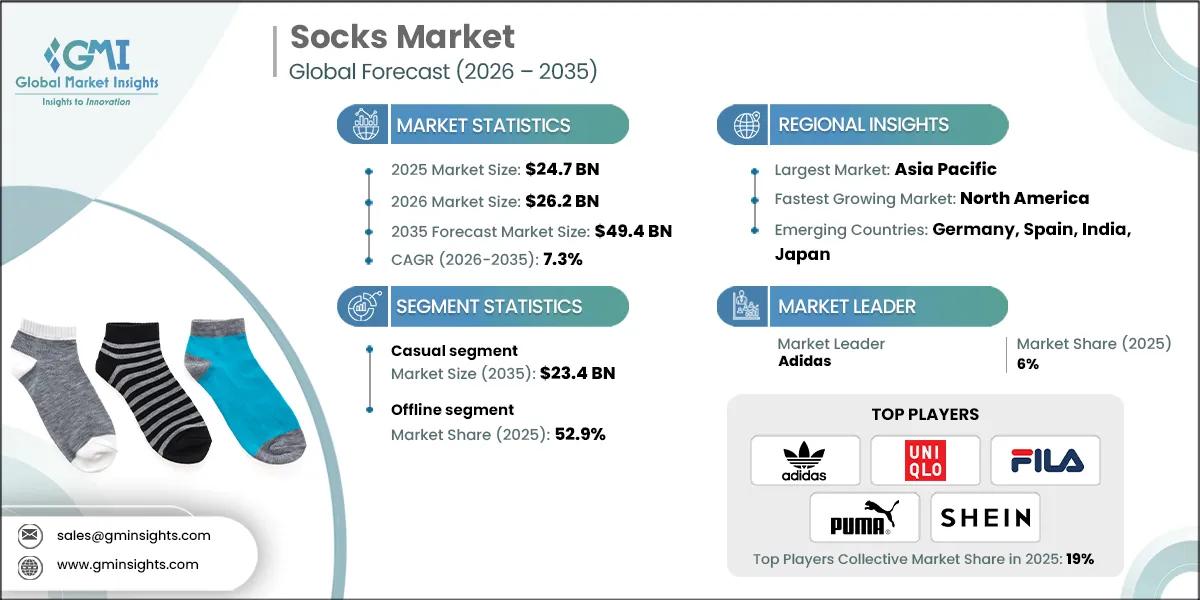
The global socks market was valued at USD 24.7 billion in 2025. According to the latest report by Global Market Insights, the market is projected to grow from USD 26.2 billion in 2026 to USD 49.4 billion by 2035, registering a CAGR of 7.3% during the forecast period.
Rising consumer focus on environmental protection and sustainability is creating growth opportunities for the socks market. Notably, young consumers are leading this trend, attaching increasing importance to eco-friendly products in their purchasing decisions. Modern consumers prefer socks made from natural materials such as bamboo fiber, organic cotton, and recycled fibers.
In addition, various government policies and initiatives are driving the global socks market toward environmental sustainability. For instance, the European Green Deal aims to reduce the environmental impact of textile waste and support manufacturers in adopting eco-friendly and sustainable production methods. The European Green Deal has prompted several manufacturers, including Bombas and Allbirds, to launch eco-friendly sock lines using sustainable and recycled materials.
Beyond policy support, consumers are increasingly aware of the negative environmental impact of textiles and tend to buy eco-friendly socks. Data from the United Nations Environment Programme (UNEP) shows that the fashion industry accounts for approximately 10% of global carbon emissions and over 20% of global water pollution. This has driven consumers to seek eco-friendly sock brands to meet the growing demand for sustainable socks.
New technologies for sustainable manufacturing are a key factor in achieving steady market growth across many industries. Biodegradable fibers and water-saving production processes enable companies to produce high-quality eco-friendly socks with minimal environmental costs. For example, Pact manufactures apparel compliant with the Global Organic Textile Standard (GOTS) using organic cotton. GOTS certification assures consumers that products are made with minimal environmental impact.
With evolving consumer trends, the introduction of sustainability regulations, and the emergence of new sustainable production technologies, the market is expected to grow significantly in the coming years, and brands will continue to adapt to meet consumer demand for more sustainable products.
Socks Market Report Attributes
|
Key Points |
Details |
|
Market Size & Growth |
Market Size & Growth |
|
Base Year |
2025 |
|
Market Size in 2025 |
USD 24.7 Billion |
|
Market Size in 2026 |
USD 26.2 Billion |
|
CAGR 2026-2035 |
7.3% |
|
Market Size in 2035 |
USD 49.4 Billion |
|
Key Market Trends |
Key Market Trends |
|
Drivers |
Impact |
|
Growing demand for eco-friendly and sustainable socks |
Eco-conscious consumers are driving demand for socks made from organic and recycled materials, creating premium pricing opportunities for brands. This trend enhances brand loyalty and positions sustainability as a key differentiator. |
|
Rising health expenditure |
Health-focused lifestyles are boosting sales of compression socks, diabetic-friendly socks, and functional socks. This shift fosters innovation in functional design and expands the medical and sportswear segments. |
|
Increasing discretionary spending |
Higher disposable income allows consumers to purchase premium, designer, and subscription-based socks. This trend is driving growth in the fashion-forward and luxury segments globally. |
|
Common Pitfalls & Challenges |
Impact |
|
Changing consumer preferences and trends |
Rapid fashion shifts and lifestyle evolution shorten product lifecycles and pose inventory risks. Brands need agile production and trend forecasting to stay competitive. |
|
Counterfeit products |
Counterfeits erode brand trust and revenue, especially in premium and sports categories. Strengthening anti-counterfeiting measures and digital authentication are critical to protecting market share. |
|
Opportunities |
Impact |
|
Growth of the sustainable eco-friendly socks market |
Eco-friendly socks, with their certification and transparency advantages, offer strong segment opportunities for brands. This opportunity aligns with global sustainability goals and the demand of high-end consumers. |
|
Expansion of smart functional socks |
Smart socks equipped with sensors (for fitness and health monitoring) open up new revenue streams. Partnerships with health tech and sports brands can accelerate adoption in high-value markets. |
|
Market Leaders (2025) |
Market Leaders (2025) |
|
Market Leader |
• AdidasMarket share 6% |
|
Key Players |
• Adidas• Uniqlo• Fila• Puma• SheinTotal market share 19% in 2025 |
|
Competitive Advantages |
• Leading brands are integrating smart fabrics and IoT functions such as sports tracking and health monitoring to enhance functionality and user experience. These innovations position companies as tech-forward and premium brands in the market.• Manufacturers are expanding their product portfolios through sustainable materials, compression technology, and modular design to cover sports, medical, and fashion segments. Advanced knitting technology and automated production improve efficiency and adaptability. |
|
Regional Insights |
Regional Insights |
|
Largest Market |
Asia-Pacific |
|
Fastest-Growing Market |
North America |
|
Emerging Countries |
Germany, Spain, India, Japan |
|
Future Outlook |
• As sustainability becomes a mainstream demand, the socks market will witness robust growth, driving the adoption of eco-friendly materials and ethical production practices. Rising health awareness will further stimulate demand for functional socks, including compression and diabetic-friendly designs.• Future innovations will focus on IoT-enabled smart socks for fitness tracking and medical monitoring, opening up new high-end segments. Automated knitting technology and advanced fabrics will enhance efficiency, customization, and better adaptation to changing fashion trends. |
Socks Market Trends
Innovation and technological change are key drivers of market growth.
· The socks industry has experienced significant growth, with the casual socks segment as the main driver propelling overall market growth by product type. The growth of the casual socks segment can be attributed to shifting consumer preferences and lifestyles, which have increased demand for multi-functional and comfortable socks. Today, casual socks have become a daily necessity, suitable for work, leisure, and sports occasions.
· In 2023, the U.S. Bureau of Economic Analysis (BEA) reported that consumer spending on clothing increased by 4.2%. This data indicates a sustained rise in demand for functional and comfortable apparel products, especially socks. Casual socks, usually made of soft and breathable fabric blends such as cotton, have become mainstream in the market while meeting comfort and functional needs.
· Top sock manufacturers such as Hanesbrands Inc. and Puma SE have successfully capitalized on the growth trend of the casual socks market through brand building and product line expansion. For example, Hanes launched the "X-Temp" series of socks designed for athletic consumers, featuring quick-drying technology to provide all-day comfort for active users.
· The popularity of hybrid work models has further boosted the growth trend of casual socks. As more employees choose to work from home, there is a growing preference for the most comfortable and functional socks, making casual socks the top choice.
· Casual socks are expected to continue their sales growth trend, driven by sustained consumer demand for multi-functional and comfortable socks, as well as continuous innovative product launches by industry leaders.
Socks Market Analysis
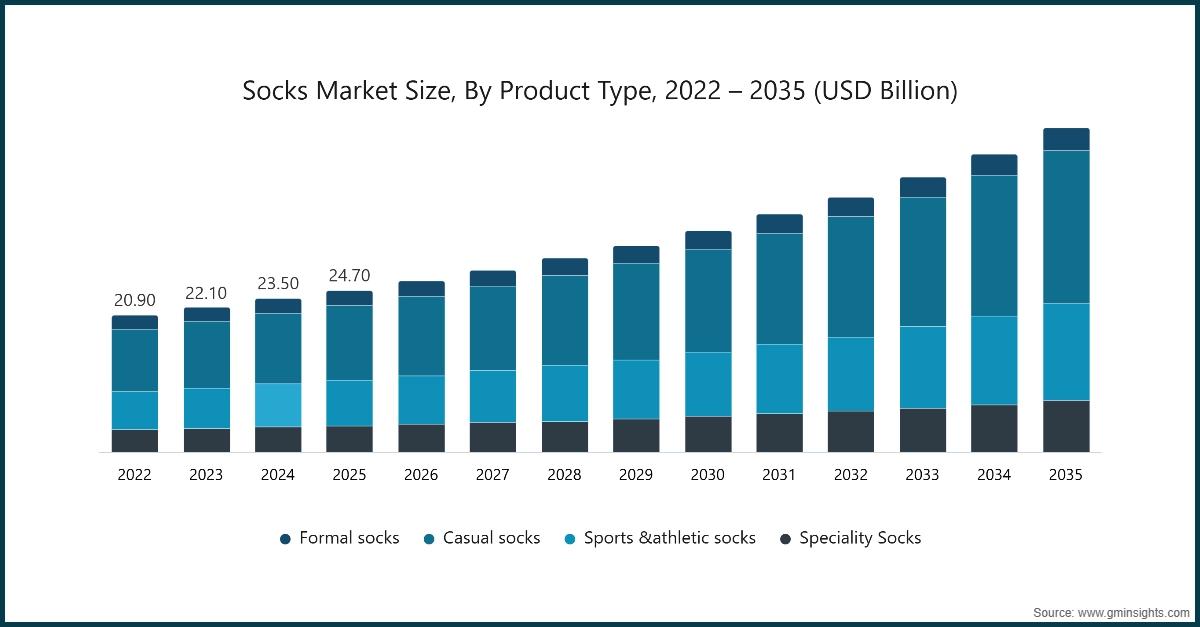
By product type, the socks market is segmented into specialty socks, sports socks, casual socks, and dress socks. Among them, the casual socks segment generated revenue of approximately USD 11.4 billion in 2025 and is projected to grow to USD 23.4 billion by 2035.
· The socks market has maintained strong long-term growth, with the casual socks segment being the primary driver of market expansion. The growth of the casual socks market stems from shifting consumer preferences and lifestyles, fueling demand for multi-functional and comfortable socks. Casual socks have become a daily essential for work, leisure, and even sports.
· In 2023, the U.S. Bureau of Economic Analysis (BEA) reported a 4.2% increase in consumer clothing spending, indicating rising demand for functional and comfortable apparel, particularly socks. Casual socks, typically crafted from soft, breathable blended fabrics (e.g., cotton), balance comfort and practicality as a market mainstay.
· Leading manufacturers like Hanesbrands Inc. and Puma SE have leveraged brand development and product diversification to capture casual socks growth. Hanes’ X-Temp line, for instance, uses quick-drying tech for all-day comfort for active users.
· Hybrid work arrangements have accelerated casual socks demand, as remote workers prioritize comfort and functionality, making casual socks their preferred choice.
· Casual socks will keep growing, supported by steady consumer demand for comfort and versatility, plus ongoing product innovation from top industry players.
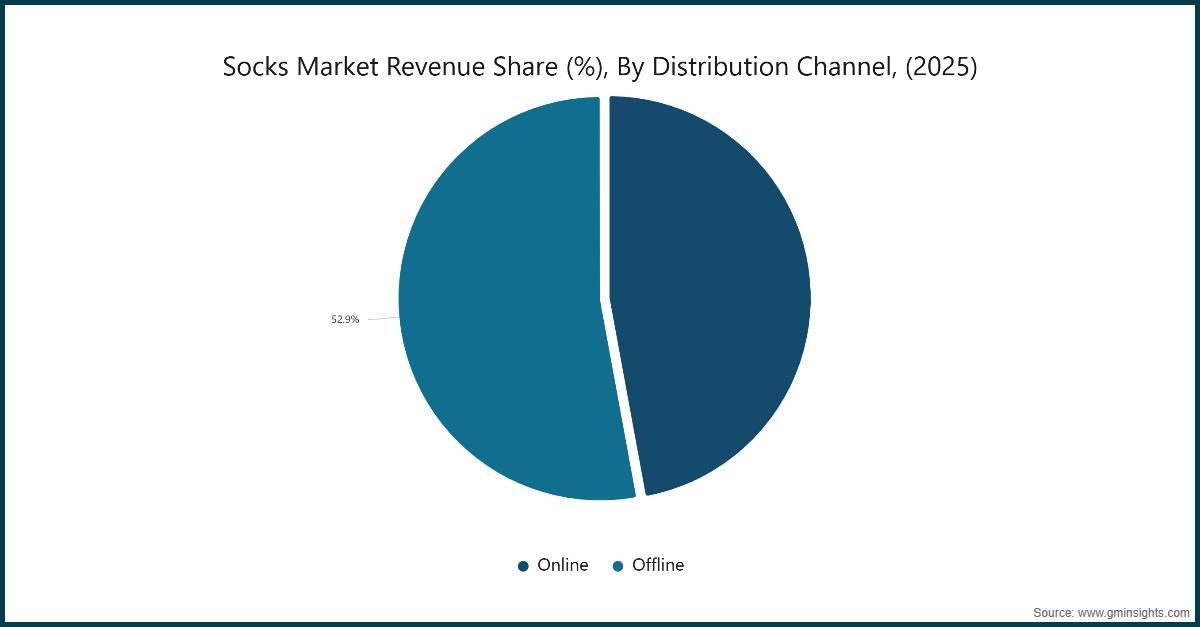
By distribution channel, the socks market is divided into online and offline channels. Offline channels held the largest global share of 52.9% in 2025.
· Offline channels dominate the socks market, driven by consumer preferences and shopping behavior. Latest data from the U.S. Census Bureau shows that physical stores accounted for approximately 85% of total U.S. retail sales in 2023. Consumers still heavily rely on physical stores, as they can see, touch, test, and try on products before purchasing—especially for comfort items like sports or medical socks.
· Retailers such as Walmart and Target exemplify providing instant product availability through extensive physical store networks, allowing customers to make immediate purchase decisions without waiting for online orders. Specialty retailers like Foot Locker offer focused sock selections to meet consumers’ specific needs.
· Another major appeal of physical retailers is the personalized service provided by store staff, helping customers choose suitable socks based on criteria such as size, material, or brand. Nordstrom is a prime example of delivering a personalized shopping experience for premium sock selections through in-store staff guidance.
· In-store promotions and discounts significantly influence customer perception of stores. According to the National Retail Federation, in-store promotions boosted foot traffic by 20% during seasonal sales in 2023. Customers take advantage of low prices and increase impulse purchases, thereby lifting overall sales.
· Therefore, offline channels with promotional strategies lead the socks market with advantages of tangible access, experiential shopping, and targeted promotions. Government statistics and practices of large retailers strongly indicate that this channel effectively meets consumer demand.
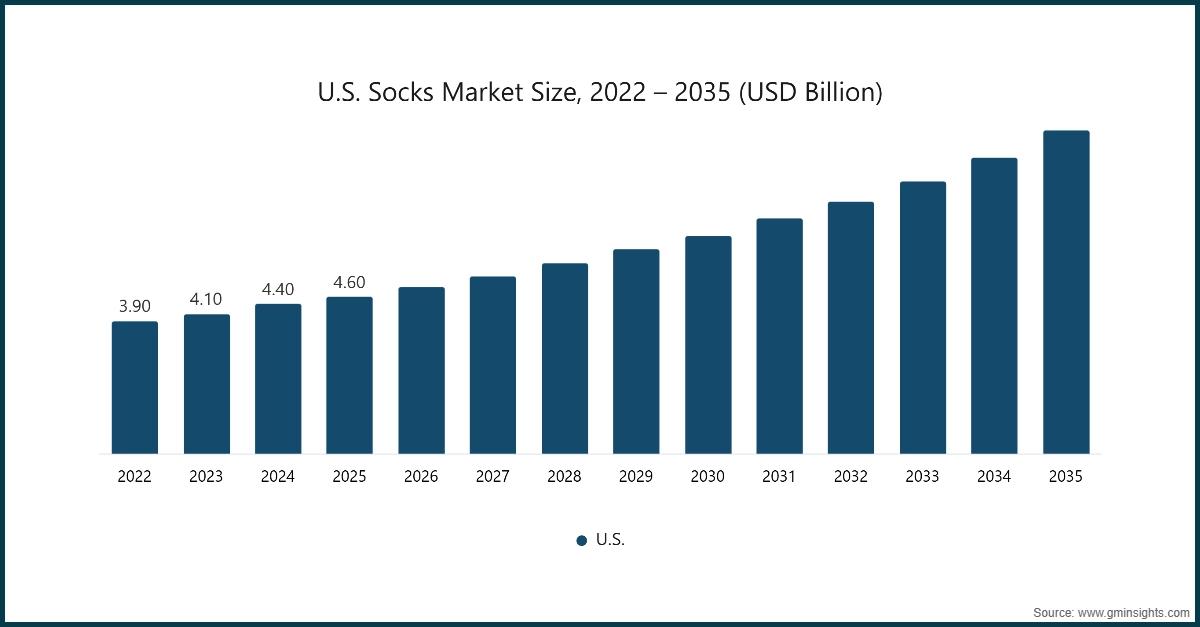
North America Socks Market
The U.S. dominated North America’s socks market growth in 2025, accounting for 59% of the regional share.
· According to the U.S. Bureau of Economic Analysis, personal consumption expenditure on apparel and footwear in the U.S. rose by 6.2% in 2025, reflecting strong discretionary spending. Additionally, the U.S. Census Bureau reported a 7.8% year-on-year increase in e-commerce sales, driving accelerated online sock purchases and subscription models.
· Furthermore, strong demand for premium and functional socks further fuels the market. High spending on sportswear and athleisure trends, coupled with rising health awareness, supports the growth of the compression and functional socks segments.
Asia-Pacific Socks Market
The Asia-Pacific market is projected to grow at a rate of 8% during the forecast period.
· Market growth is driven by rapid urbanization, rising disposable income, and the expansion of the middle class in countries such as China and India. The growing popularity of Western fashion trends and the booming development of e-commerce platforms such as Flipkart and Alibaba have further amplified demand for affordable and fashionable socks.
Europe Socks Market
The European market is projected to grow at a rate of 7% during the forecast period.
· The European market benefits from strong sustainability initiatives and consumer preference for eco-friendly products. The region’s fashion-forward culture and demand for high-end segments, especially in Germany, France, and the UK, drive innovation in organic cotton and recycled fiber socks.
Middle East & Africa Socks Market
The Middle East & Africa market is projected to grow at a rate of 6.6% during the forecast period.
· The Middle East & Africa region benefits from ongoing urbanization and deeper penetration of global fashion brands. The expansion of retail infrastructure and growing young consumer interest in athleisure styles drive demand for sports and casual socks.
Socks Market Share
Top companies in the socks industry include Adidas, Uniqlo, Fila, Puma, and Shein, which together held 19% of the market share in 2025. These well-known enterprises actively adopt strategic initiatives such as mergers and acquisitions, facility expansion, and partnerships to expand their product portfolios, customer bases, and market positions.
Adidas offers a wide range of sports and lifestyle socks, including crew, quarter, no-show styles, featuring quick-drying fabrics, cushioned soles, and compression designs tailored for athletes. The brand emphasizes sustainable materials through its "Primegreen" and "Primeblue" lines, aligning with its broader sustainability strategy.
Uniqlo’s sock product line focuses on simplicity, comfort, and functionality, covering HEATTECH thermal socks, SUPIMA cotton blends, fleece, and sports styles. All products are affordably priced, designed for the mass market and daily wear, and sold in multi-packs through an omnichannel network.
Fila’s socks combine athletic heritage with practicality, offering unisex bamboo fiber three-quarter, sports, tennis, and creative styles. Products are usually sold in multi-packs with vintage logos and cushioned support, distributed through official websites and third-party retailers.
Socks Market Companies
Key players in the socks industry include:
· Adidas
· Bombas
· Burlington Socks
· Falke
· Fruit of the Loom
· Gold Toe Brands
·